
Society of Sunflowers
mokshmails@gmail.com
March 19, 2025
Once there ruled a king who believed that all great things possessed in them an inherent sense of uniformity. Look at the ants, he remarked, “Aren’t these small yet mighty creatures capable of making empires beneath the earth due to uniform sense of identity?”. To him, this sameness was the bond which he thought created strength, stability, and a shared purpose in a species. And so he believed, that without a common thread binding people together, how could a nation truly stand united? The more he pondered, the more convinced he became that the divisions among his subjects—differences in their ways of life—stood in the way of a perfectly governed realm. If harmony was to be achieved, then his people must move as one, guided by a singular way of being. And as this idea took root in his mind, growing stronger with each passing day, it became the cornerstone upon which he decided to reshape his kingdom.
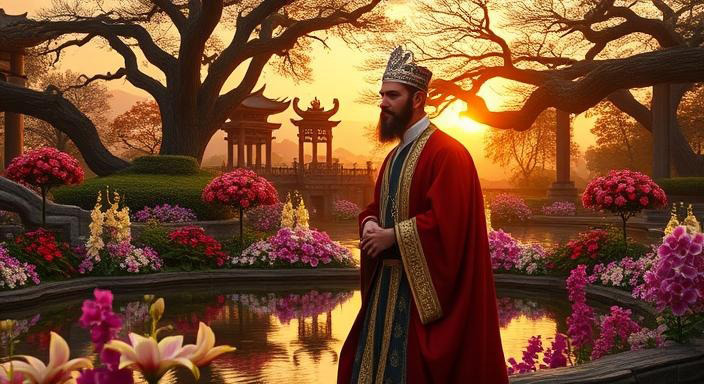
One evening, as the king sat deep in thought, he summoned his most trusted minister, a man known for his wisdom and foresight. They met as they often did, in the quiet embrace of the Imperial Garden, where conversations of consequence unfolded under the open sky. The air was thick with the mingling fragrances of lilies and violets, the evening breeze carrying the faint rustle of leaves and the distant murmur of flowing water. And as they walked along the stone pathways, the king spoke of his vision, his voice steady with conviction. Orchids stood in silent bloom, their intricate petals catching the last light of day, while willows bent gracefully over a still pond, where koi fish moved in slow, deliberate arcs beneath floating lotus leaves. Here, beneath the shade of towering trees, the world seemed untouched by the struggles of the kingdom beyond its walls.
Yet, for all its beauty, the king hardly noticed these things. His thoughts were elsewhere, fixed upon the great challenge of governance, the delicate task of uniting his people under a single order. It was this question that weighed upon him, and for which he now sought the counsel of his most trusted aide. The minister, however, allowed a moment’s pause, letting the silence stretch between them as he took in the world around them—a world of quiet harmony, where nothing was the same, yet everything belonged.
And as they strolled along the marble pathways, the king spoke, his voice carrying the weight of years spent ruling a divided land, “Oh Minister, for twenty years, I have sat upon the throne and watched my people tear themselves apart. I have seen how inequality fuels oppression. How religion is sowing discord. How wealth has built walls around men. How the rich look upon the poor with indifference, while the poor glare back with resentment in their eyes. The majority wields its strength with arrogance instead of kindness, while the minority cowers in fear and disillusionment from the masses. This fractured existence is weakening our kingdom from within.” And as he paused, his gaze swept across the vibrant garden before him, its colours vivid, its life unrestrained. Yet, to him, even this beauty seemed a reflection of the chaos he sought to control. Turning to his minister, he continued, “As I approach the end of my rule, I have decided to put an end to this strife. No more inequality, no more class, no divisions of wealth or faith. I will forge a single, unshakable identity for all. No division of opinions. One people. One order. That will be my legacy. That will be my utopia. Tell me, wise minister, what do you think?”.
The minister, having spent a lifetime by the king’s side, was a man of deep foresight and caution. He knew well that the king’s mind was a fortress—one that could not be breached through direct opposition. To challenge him outright would be folly of the highest order. And so, he chose his words with care. “I understand your vision, My Lordship,” he said, his tone deferential. “Uniformity will bring order. If you permit me a few months, I shall craft a plan to achieve this harmony across the kingdom.”
The king was pleased. The minister’s measured agreement reinforced his belief that his vision was irrefutable. With a nod of approval, he granted the minister time, confident that the kingdom would soon stand unwavering, undivided, unbreakable.
Weeks passed, and the king awaited the minister’s grand design. But the minister remained silent. He issued no decrees, restructured no laws. Instead, he called for the royal gardener—an old man who had tended the palace grounds long before the king himself had ascended the throne.
“Remove the lilies, the violets, the roses, the orchids,” the minister instructed. “One by one. Let the change be gradual, imperceptible. In their place, plant sunflowers. Let them spread, until no other plant remains.”
And so, the gardener obeyed. At first, the transformation was subtle. The king continued his morning walks, unaware of the quiet shift unfolding around him. But in time, the bursts of color that had once danced in the sunlight faded. The rich mingling of fragrances in the air grew still, replaced by the faint, singular scent of sunflowers. The intricate petals of orchids and violets vanished, overtaken by sturdy, identical golden faces—each one turned toward the sun. There was order. There was uniformity. The garden had become a flawless expanse of synchronized motion, a symbol of life in rigid perfection.
And then, one morning, the king paused.
His steps slowed. A frown creased his brow as an unfamiliar emptiness settled over him. At first, he could not discern what was wrong. But as he looked around, realization dawned.
He turned to the royal gardener. “Where are the lilies, the roses, the violets?” he demanded. “Why does this garden no longer sing with colour as it once did?”
The gardener hesitated, bowing low. “Your Majesty, I have done only as the grand minister commanded. I have replaced all the plants in the garden with sunflowers.”
The king’s eyes darkened with confusion. “But why?”
And so, the minister was summoned.
Calm and composed, the minister met the king’s gaze with quiet wisdom. His voice was steady, yet firm. “Your Majesty,” he said, “we all turn to you as the sunflower turns to the sun. You are our guide, our light, the force that binds the kingdom together. But tell me, my king, is the sun’s greatness measured by the number of flowers that bow before it? Or by the life it nurtures in all things?”.
The king remained silent. The minister continued, his words deliberate, each one sinking into the still morning air. “Look at this garden, Your Majesty. It is orderly, predictable, uniform. But is it not lesser? True harmony does not arise from forcing sameness, nor does strength lie in eliminating differences. The sun does not choose which flower may bloom and which must wither—it shines upon all alike. The lilies, the violets, the trees, the wildflowers, even the weeds. And in this diversity, the garden thrives.”
The king exhaled slowly as understanding settled over him. The minister had not opposed him, nor argued. Instead, he had shown him the weight of his own choices. He had sought to erase division by imposing uniformity, but in doing so, he had stripped his people of their essence. A kingdom, like a garden, did not flourish through rigid sameness, but through balance—the coexistence of strength and fragility, tradition and change, order and freedom.
The minister did not press further. Some lessons, he knew, must settle like seeds into fertile soil—germinating in their own time, unfolding their wisdom with the patience of nature itself.
At last, the king turned to the gardener, his voice steady, no longer burdened by the weight of his former convictions. “Bring back the lilies, the violets, the orchids. Let the roses bloom once more.”
And so, in time, the garden flourished again—not as a rigid field of gold, but as a symphony of colours. Each petal different, yet all belonging. And in its revival, the kingdom, too, found its harmony. After all, a true kingdom is not found in a society of sunflowers, but in the wildness of diversity.

Moksh Ranawat
Welcome to my corner of the internet! I’m Moksh, a lawyer by profession, a writer by passion, and an explorer of stories—both real and imagined.